CE Mark Retainer Cleaners Europe: Avoid Risks
The European orthodontic market is expanding rapidly, driven by the massive popularity of clear aligners and retainers. For dental product distributors, pharmacy chains, and e-commerce brand owners in the EU, selling private-label oral care consumables is a highly profitable strategy. However, the European Union has some of the strictest regulatory frameworks in the world. If you want to sell dental cleaning tablets legally and avoid costly customs seizures, understanding the CE marking process is not just an option—it is a mandatory business requirement.
Quick Summary for Sourcing Managers
- Classification is the first step: Retainer cleaning tablets are typically classified as Class I Medical Devices under the EU MDR (Medical Device Regulation 2017/745), requiring specific compliance steps.
- Documentation is critical: To obtain a CE mark, distributors must compile a comprehensive Technical File, including safety data, efficacy testing, and risk management reports.
- Your factory partner matters: Working with an OEM manufacturer that already holds ISO 13485, FDA, and Sedex certifications drastically reduces your time-to-market and ensures your CE compliance is backed by real factory data.
Whether you are a seasoned procurement manager or a new brand founder, this guide will explain exactly how to secure a CE mark retainer cleaners Europe strategy, ensuring your supply chain remains safe, legal, and profitable.
What is a CE Mark and Why Do Retainer Cleaners Need It?
The letters “CE” are an abbreviation of the French phrase “Conformité Européenne,” which translates to “European Conformity.” When a CE mark is placed on a product, the manufacturer or the authorized EU importer declares that the product meets all the essential health, safety, and environmental protection requirements of the applicable European directives and regulations.

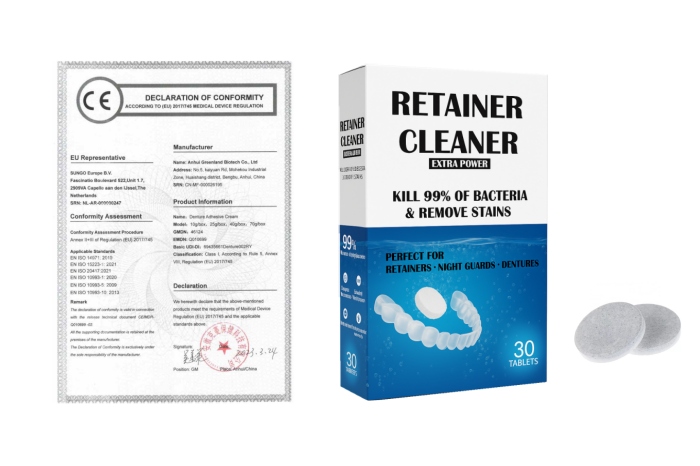
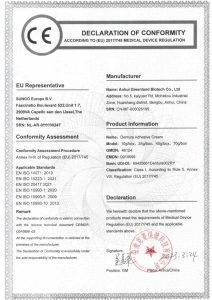
For B2B distributors importing goods from outside the EU (such as from a manufacturing partner in China), the responsibility of ensuring CE compliance often falls on the importer or the “brand owner” placing the product on the market. Without a valid CE mark and the corresponding Declaration of Conformity (DoC), your retainer cleaning tablets cannot legally pass through European customs or be sold on platforms like Amazon Europe.
Classifying Your Product: Medical Device vs. General Product
The most complex part of European compliance is deciding which regulation applies to your product. For oral care items, the line can sometimes seem blurry, but the European Medicines Agency (EMA) and national competent authorities are very strict.
When is it a Medical Device (EU MDR 2017/745)?
If your marketing materials, packaging, or instructions claim that the tablet is specifically intended to clean, disinfect, or maintain a medical device (such as an orthodontic retainer, clear aligner, or denture), your cleaning tablet is treated as an accessory to a medical device. Under the EU Medical Device Regulation (MDR 2017/745), these are generally classified as Class I Medical Devices.
When is it a Cosmetic or General Product?
If your product only claims to “freshen breath” or “whiten natural teeth” without mentioning the cleaning of dental appliances, it might fall under the Cosmetic Regulation. However, since the core function of a retainer tablet is to remove plaque and bacteria from an external plastic appliance, the MDR route is the standard and legally safest path for B2B distributors.
Comparison: MDR vs. General Safety for Dental Tablets
| Regulatory Feature | Class I Medical Device (EU MDR) | General Product / Cosmetic |
| Primary Intended Use | Cleaning and disinfecting dental appliances (retainers, aligners). | General cleaning or breath freshening for natural teeth. |
| CE Mark Required? | Yes, strictly required. | No CE mark for cosmetics (but CPNP registration is needed). |
| Quality System Needed | ISO 13485 is highly recommended/expected. | Good Manufacturing Practice (GMP) / ISO 22716. |
| Notified Body Involvement | Not usually required for basic Class I (Self-Declaration). | N/A |
| Post-Market Surveillance | Mandatory strict reporting system for adverse events. | Basic safety monitoring. |
Note: Always consult with an EU regulatory affairs consultant to confirm the exact classification based on your specific label claims.
Step-by-Step Guide to the CE Marking Process
If you are a European distributor sourcing private-label retainer tablets, here is the standard roadmap to achieving CE compliance.
1. Confirm the Classification
As established, confirm that your product is a Class I Medical Device under the MDR. This allows you to use the “Self-Certification” route, meaning you do not need to hire an expensive third-party Notified Body to audit your product, provided you have all the correct documentation.
2. Compile the Technical File
This is the most labor-intensive part of the process. The EU authorities require a Technical File that proves your product is safe and does what it claims to do. A solid Technical File includes:
- Product Description: Exact chemical formulations and ingredient lists.
- Safety Data Sheets (SDS): Chemical safety profiles for shipping and handling.
- Efficacy Testing: Laboratory reports proving that your tablet actually kills 99.9% of bacteria or removes plaque within the stated time (e.g., 3 minutes).
- Risk Management Report: Following ISO 14971 standards to show you have minimized any risks to the user.
- Labeling and Instructions for Use (IFU): Your packaging must include specific symbols, the CE mark, and clear instructions in the language of the target EU member state.
3. Appoint an Authorized Representative (EC REP)
If your company is based outside the EU (for example, a UK brand selling into the EU post-Brexit, or an American distributor), you must appoint a European Authorized Representative (EC REP). Their address will go on your packaging, and they act as the liaison between you and the European health authorities.
4. Issue the Declaration of Conformity (DoC)
Once your Technical File is complete and you are confident the product meets all MDR requirements, you (or your company) will sign a Declaration of Conformity. This is a legally binding document stating that you take full responsibility for the product’s compliance.
5. Affix the CE Mark
Finally, you can legally print the CE mark on your retainer cleaner tubes, foil pouches, and retail boxes.
How Our Manufacturing Facility Simplifies European Compliance
Compiling a Technical File is nearly impossible if you are working with a low-tier factory that hides its formula or lacks proper quality control. The data required by European authorities—such as material safety, stability testing, and batch traceability—must come directly from your OEM manufacturer.
This is where your choice of a B2B supply chain partner becomes a massive competitive advantage. At ITS Dental Care, we do not just mix powders; we engineer compliance into our production lines.
We fully support our European distributors because our manufacturing facility operates under the highest global standards. We hold ISO 13485 certification, which is the foundational quality management system required for medical devices under the EU MDR.
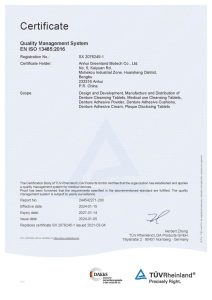
Furthermore, our commitment to quality and transparency goes beyond Europe. We are FDA registered for the US market, our products meet CE certification standards, and we are Sedex certified. The Sedex certification is particularly important for modern European buyers, as it proves our factory adheres strictly to ethical labor practices, health and safety regulations, and environmental sustainability—key factors for Environmental, Social, and Governance (ESG) reporting in the EU.
When you source your private label retainer tablets from us, we provide the robust laboratory testing data, the ingredient safety profiles, and the manufacturing transparency you need to pass your CE compliance checks smoothly.
You can learn more about our rigorous quality control processes, our automated production lines, and our full list of global certifications on our About us page.
Sourcing Safely: Why Your OEM Partner Matters
In the B2B oral care industry, cutting corners on compliance will eventually destroy your profit margins. If a European customs agent requests your Technical File and your supplier cannot provide the dissolution test data or the microbiological safety reports, your entire shipment will be blocked at the port.
By partnering with a factory that already understands the technical demands of the CE mark, you eliminate these supply chain bottlenecks. You spend less time worrying about chemical regulations and more time focusing on what really matters: marketing your brand, securing retail shelf space, and growing your B2B distribution network.
Secure Your European Market Share Today
Navigating the CE marking process for retainer cleaners in Europe requires diligence, accurate documentation, and a highly capable manufacturing partner. By understanding the MDR classification and ensuring your supply chain meets ISO 13485 standards, you can build a compliant, high-margin oral care brand that European consumers trust.
Are you ready to launch or scale your retainer cleaning brand in the European market? Do not let regulatory hurdles slow you down. Partner with a factory that provides medical-grade quality and full compliance support.
Take the next step: Contact our B2B sourcing team today to discuss your OEM/ODM requirements. We offer flexible MOQs, custom packaging solutions, and full support for your compliance needs.
- Visit our About page to verify our ISO, FDA, CE, and Sedex credentials.
- Browse our full catalog on our Products page to find the perfect products for your brand.
Reach out now for a wholesale quote and request your free white-label samples today!
FAQ for B2B Procurement Managers: Navigating EU Compliance
Q1: If we switch our manufacturing to your facility, can we use our existing CE Technical File, or do we need to start from scratch?
A: You cannot simply transfer your old file. You must update your Technical File with our specific formulation, Safety Data Sheets (SDS), and ISO 13485 manufacturing records. Because the CE mark under the EU MDR is intrinsically tied to the exact manufacturer’s quality management system and raw material specifications, selling under an old file is a severe compliance violation that can lead to immediate product recalls.
- Industry Tip: Always ask a new OEM partner if they provide a “ready-to-use” compliance data package. At ITS Dental Care, we provide our European distributors with pre-compiled laboratory testing data, saving you months of expensive third-party lab testing and accelerating your compliance update.
Q2: How do you guarantee batch-to-batch consistency so that our CE compliance remains valid throughout mass production?
A: We guarantee consistency through strict adherence to ISO 13485 protocols and Automated Optical Inspection (AOI). A CE mark is not a one-time pass; it requires continuous compliance. We enforce raw material quarantine and testing before mixing, strict environmental moisture control during the effervescent pressing stage, and we retain samples from every single production batch for long-term stability tracking.
- Industry Tip: Demand a Certificate of Analysis (CoA) with every bulk shipment. If a supplier hesitates to provide batch-specific CoAs showing active ingredient percentages and microbiological safety, your CE mark is at severe risk during a random market surveillance audit.
Q3: We plan to sell in both the EU and the UK. Does your manufacturing data support both the CE Mark and the UKCA Mark?
A: Yes, absolutely. Post-Brexit, the UK requires the UKCA mark, while the EU requires the CE mark. Fortunately, the fundamental safety, efficacy, and ISO 13485 manufacturing requirements overlap significantly. Our laboratory data, efficacy reports, and safety profiles are structured to support your compliance submissions for both regulatory bodies simultaneously.
- Industry Tip: Consolidate your packaging design early. Print both the CE and UKCA marks (along with their respective Authorized Representative addresses) on your retail boxes from your very first production run. This helps you avoid the costly MOQ (Minimum Order Quantity) trap of ordering two separate packaging batches for different regions.
Q4: What happens if an EU competent authority requests to audit our supply chain? Will you provide the necessary transparency?
A: Yes, we operate with full traceability and transparency. Under the EU MDR, competent authorities have the right to request documentation down the supply chain. Because our facility is routinely audited for FDA, ISO 13485, and Sedex (ethical supply chain) standards, our records are always audit-ready. We will work directly with your company or your European Authorized Representative (EC REP) to supply any required manufacturing and QC documentation.
- Industry Tip: Never sign a Contract Manufacturing Agreement (CMA) without a clear “Right to Audit” and “Regulatory Support” clause. Your factory must be legally bound to assist you during an EU compliance check, not just disappear after the goods are shipped.
You may also interested in: