How to Use Denture Adhesive Cream?
Loose dentures cause social anxiety and make eating difficult for your customers. Many users struggle with adhesives because they simply do not know the correct application method, leading to product waste and frustration.
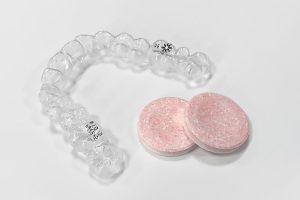
Denture adhesive cream is a water-soluble compound that creates a seal between the gum and the denture base. To use it, clean the denture with denture cleansing tablets, dry it thoroughly, apply small dots of cream, and press firmly into place. This guide explains the precise steps, safety tips, and removal methods to ensure a secure hold all day.
At ITS Dental Care Products, we know that the success of a private label product relies on end-user education. When your customers know how to use the adhesive correctly, they buy more regularly and complain less. Let’s look at the best practices for using denture adhesive cream effectively.
Quick Answer for Busy Readers (30-Second Guide)?
Your customers want immediate results and often skip detailed instructions. If they apply the cream incorrectly, they will blame the product quality rather than their technique.
Here is the essential information for a quick understanding:
- What it is: A paste that swells with saliva to fill gaps between gums and dentures.
- When to use it: When dentures are slightly loose, or for extra security during public speaking and eating tough foods.
- Simple steps: Clean, Dry, Apply small dots (not strips), Insert, and Hold for a few seconds.
- Avoid: Do not apply to wet dentures and do not overfill the denture.
This quick summary helps you understand the core function of the product. However, to truly serve your market and provide the best guidance on your packaging or marketing materials, we need to look closer at the details.
What denture adhesive cream is
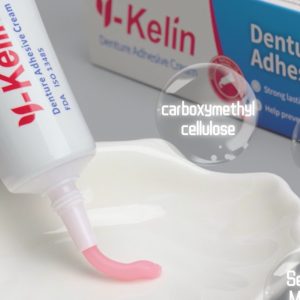
It is not a “glue” in the traditional sense. It is a soft paste usually made from polymaleates or carboxymethylcellulose. These ingredients interact with saliva. They expand and become sticky. This creates a physical lock and a viscosity lock. It acts like a gasket or a seal. It fills the microscopic space between the hard acrylic of the denture and the soft tissue of the gums.
When you should use it
Adhesive is best for “peace of mind.” It is great for new denture wearers adapting to the foreign feeling. It is also vital for those with flat gum ridges (resorption) where suction is hard to achieve naturally. It should not be used to force a denture to fit if the denture is warped or broken. If the gap is too large, the cream cannot bridge it.
Simple steps to apply it correctly
The rule is “less is more.” Many users think more paste equals a stronger hold. This is false.
- Clean: Remove food debris and old adhesive.
- Dry: This is the most missed step. Water repels the adhesive initially.
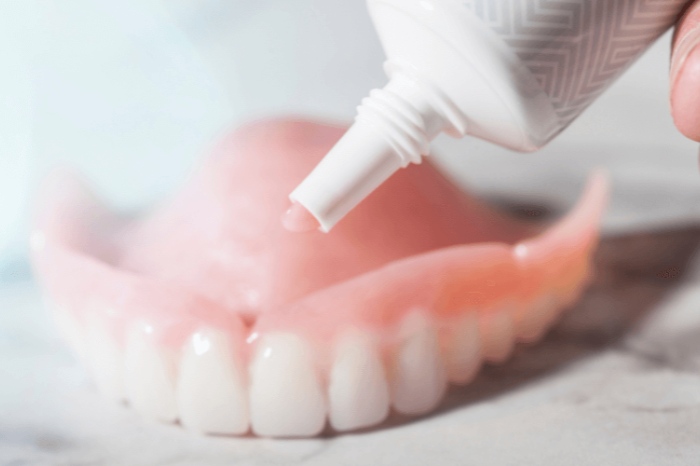
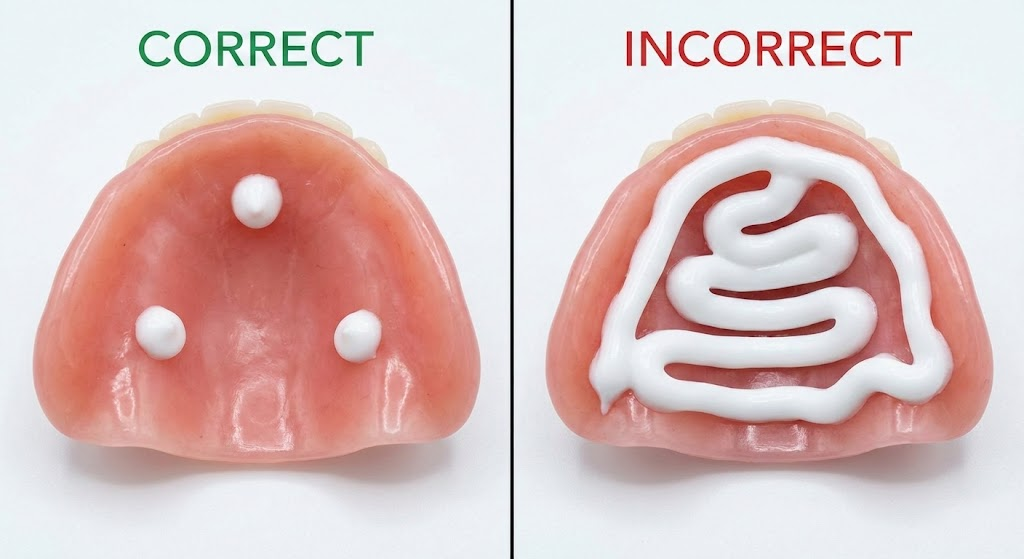
- Apply: Three to four pea-sized dots are usually enough for an upper denture.
- Wait: Do not eat or drink for 15-30 minutes after insertion to let the bond set.
Common mistakes to avoid
The biggest mistake is “oozing.” If cream squeezes out the sides when the user bites down, they used too much. Another mistake is irregular cleaning. Old adhesive builds up and creates bumps. This hurts the gums and prevents a good seal the next day. Also, using adhesive to mask a painful infection or a sore spot is dangerous.
| Feature | Correct Usage | Incorrect Usage |
| Amount | Small dots or thin strips | Thick layers filling the trough |
| Surface Condition | Completely dry | Wet or damp from rinsing |
| Removal | Daily cleaning | Leaving residue for days |
| Purpose | Security and comfort | Fixing broken dentures |
Figure 1: Comparison of correct vs. incorrect adhesive application amounts on a denture.
What Is Denture Adhesive Cream and How Does It Work?
Understanding the mechanism of action helps you explain why “less is more” to your customers. It isn’t glue; it’s a gap-filler.
The Science of Adhesion
Denture adhesive cream is typically composed of water-soluble polymers (like carboxymethylcellulose or PVM/MA copolymer). When these ingredients come into contact with saliva, they hydrate and expand. This expansion increases the viscosity of the saliva between the denture and the gum, creating two types of forces:
- Cohesive Force: The sticky strength of the adhesive itself.
- Adhesive Force: The bond between the cream and the oral tissue/denture base.
Why It Improves Comfort
The primary function is to eliminate the “air gap.” Even the best-made dentures have microscopic spaces between the acrylic and the soft tissue. The adhesive fills these voids, preventing food particles (like seeds or nuts) from getting trapped underneath, which is a major cause of gum irritation.
Target Audience for Your Sales
- Ideal Users: Patients with resorbed ridges (flat gums), public speakers, musicians, and new denture wearers.
- Non-Ideal Users: People with broken dentures or ill-fitting dentures that need relining. If a customer is buying a tube every week, they need a dentist, not more adhesive.
Figure 2: Ingredients vs. Function
| Ingredient | Function | Why it matters to the buyer |
| Carboxymethylcellulose (CMC) | Initial tack/grab | Provides immediate hold upon insertion. |
| PVM/MA Copolymer | Long-term hold | Sustains the bond throughout the day. |
| Mineral Oil/Petrolatum | Base/Vehicle | Allows the cream to extrude smoothly from the tube. |
When Do You Really Need Denture Adhesive Cream?
Is adhesive a crutch or a tool? For your business clients, positioning this correctly ensures repeat sales without over-promising.
Signs Dentures Need Extra Hold
The most obvious sign is movement during laughing, yawning, or sneezing. However, a subtle sign is “fear of eating.” If a user avoids apples or steak because they worry about their teeth shifting, they are a prime candidate for adhesive.
New vs. Old Dentures
- New Dentures: The mouth changes shape after extraction. Immediate dentures often become loose within months as the bone heals and shrinks. Adhesive is a vital bridge solution during this 6-12 month healing period.
- Old Dentures: Over years, the jawbone naturally resorbs (shrinks). A denture that fit 10 years ago will not fit today. Adhesive helps, but you should encourage customers to seek professional relining if they need massive amounts of cream.
The Confidence Factor
In the B2B context, you are selling “social security.” Studies show that even when a denture fits well, the psychological benefit of using a small amount of adhesive improves a patient’s bite force and willingness to socialize. This is a key selling point for your marketing copy.

How to Prepare Your Dentures Before Applying Adhesive?
This is the step where 80% of user errors occur. If the surface isn’t prepped, the chemical reaction won’t happen correctly.
Clean Your Dentures Properly First
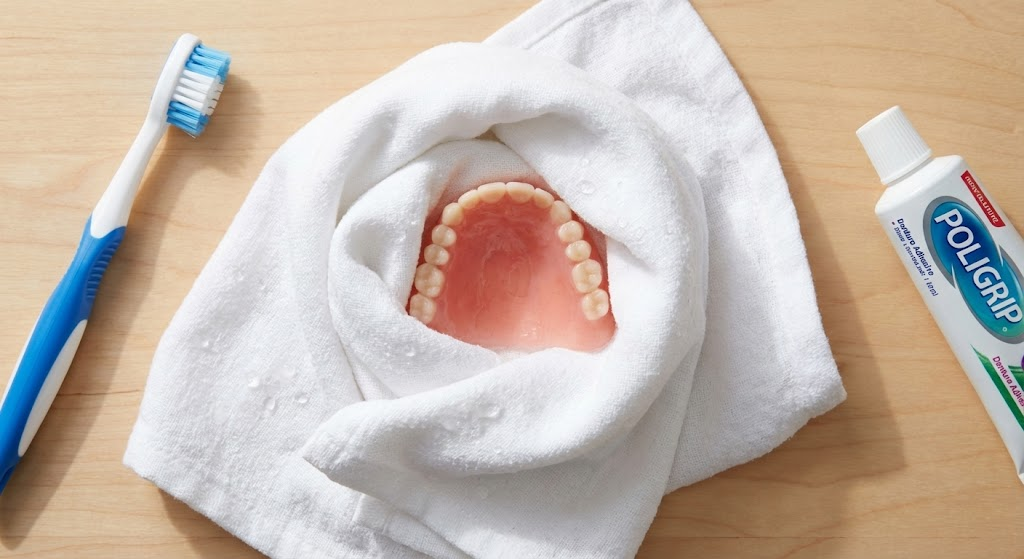
Old adhesive residue prevents new adhesive from grabbing the acrylic. It’s like trying to put a sticker on a dusty window—it just won’t stick. We recommend instructing users to soak their dentures in a solution made with denture cleansing tablets to break down the biofilm before scrubbing.
Dry Dentures: The Critical Step
Why does this matter? The polymers in the cream are hydrophilic (water-loving). If the denture is wet when you apply the cream, the polymers react immediately with that water before the denture is in the mouth. This weakens the bond. The denture surface must be bone dry so the reaction only starts once it hits the saliva in the mouth.
How Much Adhesive You Actually Need
The goal is a thin film, not a cushion. If the user feels the denture is “elevated” or their bite feels high, they have used too much.
Preparation Checklist for Your Packaging:
- Brush off loose debris.
- Soak to kill bacteria.
- Wipe completely dry with a towel.
- Check for old glue residue.
How to Apply Denture Adhesive Cream (Step-by-Step)?
Clear instructions reduce product misuse and negative reviews. Here is the standard protocol we recommend for our private label clients.
Step 1: Where to Place the Adhesive Cream
- Upper Denture: Apply three small dots—one in the front (rugay area) and two on the sides toward the molars. Do not put cream too close to the back edge, or it will cause gagging.
- Lower Denture: Apply two or three small dots along the ridge. The lower denture has less surface area, so precision is key.
- Partial Denture: Use tiny dots only on the center of the saddle area that touches the gum.
Step 2: How Much Cream is Too Much?
As a manufacturer, we see customers using half a tube in a week. This is incorrect. A standard 40g tube should last a user at least 3 to 4 weeks. If it runs out sooner, they are over-applying. “Oozing” is the red flag. If cream spills out, dial back the dosage next time.
Step 3: Inserting Dentures the Right Way
Don’t just pop them in.
- Place the denture in the mouth.
- Bite down firmly for a few seconds to seat it.
- Use your fingers to press up (for uppers) or down (for lowers) to ensure contact with the tissue.
Step 4: Wait Time Before Eating or Drinking
The chemical bond needs time to set. Advise users to wait 15 to 30 minutes before eating or drinking hot liquids. Cold water is generally fine, but hot liquids can dissolve the adhesive before it cures.
Common Mistakes People Make with Denture Adhesive Cream?
Troubleshooting these issues for your customers positions your brand as an expert in oral care.
Using Too Much Adhesive
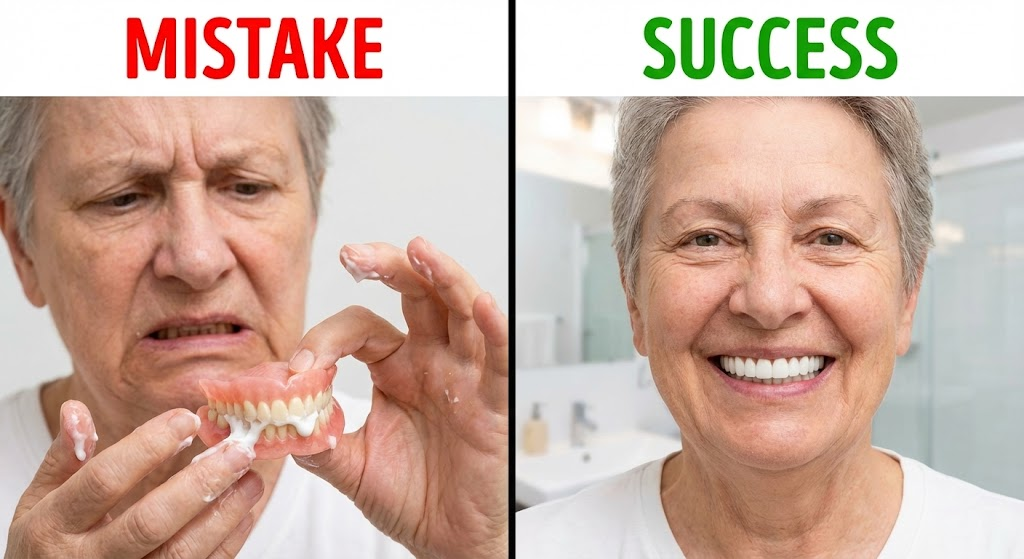
This is the #1 complaint. Users think “more glue = better hold.” In reality, a thick layer creates a pivot point, making the denture wobble more. It also creates a mess that is hard to clean.
Applying Adhesive to Wet Dentures
As mentioned, moisture triggers the setting process prematurely. If the cream slides off the denture before insertion, the surface was likely wet.
Using Adhesive to “Fix” Ill-Fitting Dentures
We must be ethical in our sales. If a denture is rocking severely, adhesive is a temporary bandage, not a cure. Prolonged use on bad dentures can cause tissue hyperplasia (flabby gums) because of uneven pressure.
Ignoring Daily Denture Cleaning
Layering new adhesive over old adhesive creates a breeding ground for Candida albicans (thrush). The denture must be stripped clean every night.
Troubleshooting Table
| Symptom | Probable Cause | Solution |
| Cream oozing out | Too much product | Use smaller dots next time. |
| Hold lasts only 1 hour | Wet application or hot liquids | Dry denture thoroughly; wait before coffee. |
| Gagging sensation | Applied too far back | Keep cream away from the rear palatal seal. |
| Hard to remove | Too much product | Use less; rinse with warm water before removal. |
How Long Does Denture Adhesive Cream Last?
Managing expectations is key to customer satisfaction in the B2B dental market.
Typical Holding Time During a Full Day
A high-quality adhesive (like those formulated by ITS Dental Care) should provide 12 hours of hold. This covers a standard day of meals and conversation. However, this varies based on the individual’s saliva flow and the fit of the denture.
What Affects Adhesive Performance?
- Hot Liquids: Hot soup or coffee can melt the adhesive barrier faster than cold foods.
- Saliva Consistency: Patients with Xerostomia (dry mouth) may actually struggle with adhesive because moisture is needed to activate the polymers. Conversely, excessive salivation can wash it away.
- Bite Force: Eating very tough foods (steak, sticky candy) puts shear force on the bond, breaking the seal.
When to Reapply (and When Not To)
Adhesive is designed for once-daily application. If a user has to reapply after lunch, they are either using the product wrong or their dentures fit poorly. Continually adding fresh cream over saliva-soaked old cream rarely works well.
How to Remove Denture Adhesive Cream Safely?
The removal process is often harder than the application, leading to gum irritation if done roughly.
Removing Dentures Without Pain
Do not yank the denture.
- Swish with warm water or mouthwash. This loosens the seal.
- Rock the denture gently from side to side.
- Introduce air: Puff out your cheeks to break the suction seal.
- Pull down (or up) gently.
Cleaning Adhesive Residue from Dentures
Dry brushing is difficult. Immersing the denture in a soak solution is best. For stubborn residue, use a soft-bristle brush under warm running water. Avoid boiling water, which warps the acrylic.
Keeping Gums Healthy After Removal
Residue often sticks to the roof of the mouth. Do not scrub hard with a toothbrush, as this damages delicate tissue. Instead, use a washcloth soaked in warm water or a piece of gauze to wipe the gums clean. Massaging the gums also stimulates blood flow, which is crucial for long-term oral health.
Denture Adhesive Cream Safety Tips You Should Know?
Safety compliance is a major concern for B2B buyers importing medical devices. You need to assure them of the product’s safety profile.
Is Daily Use Safe?
Yes, provided the product is used as directed. The FDA and other regulatory bodies classify denture adhesives as medical devices. However, chronic overuse (using a tube every 2-3 days) can lead to excessive ingestion of ingredients.
Zinc vs. Zinc-Free Formulas
Some older adhesives contained Zinc to boost retention. Excessive ingestion of Zinc over years can cause neurological issues (neuropathy).
Gum Care and Oral Hygiene Tips
Adhesive traps bacteria if not cleaned. We recommend rotating between adhesive use and “gum rest” periods (sleeping without dentures) to prevent fungal infections.
When to Talk to a Dentist
If the adhesive fails to hold for more than 1-2 hours, the denture likely needs a hard reline or replacement. Adhesive cannot fix structural jaw issues.
Final Tips for Better Results with Denture Adhesive Cream
Maximizing the value of the product ensures your brand gets positive reviews and re-orders.
Storage and Handling Tips
- Cap Hygiene: Always wipe the nozzle and cap dry before closing. If water gets into the tube, the cream will harden inside the nozzle, making it impossible to squeeze out.
- Temperature: Store at room temperature. Cold adhesive is hard to squeeze; hot adhesive separates (oil separates from solids).
Choosing a High-Quality Adhesive Cream
Not all adhesives are equal. Cheap fillers result in short hold times. As a buyer, look for formulations with balanced copolymers for both “snap set” (immediate hold) and “long duration” (all-day hold).
How Proper Use Saves Money and Frustration
Educating your customer that “a little goes a long way” creates a better user experience. They save money by not wasting product, and they get a better, cleaner fit.
Conclusion: Use Denture Adhesive Cream the Smart Way
Denture adhesive cream is a powerful tool for comfort and confidence, but only when used correctly. For your business, success lies in providing not just a product, but the expertise to use it.
By ensuring your customers Clean, Dry, and Apply sparingly, you guarantee them a secure hold and a positive experience with your brand.
You may also interested in: